
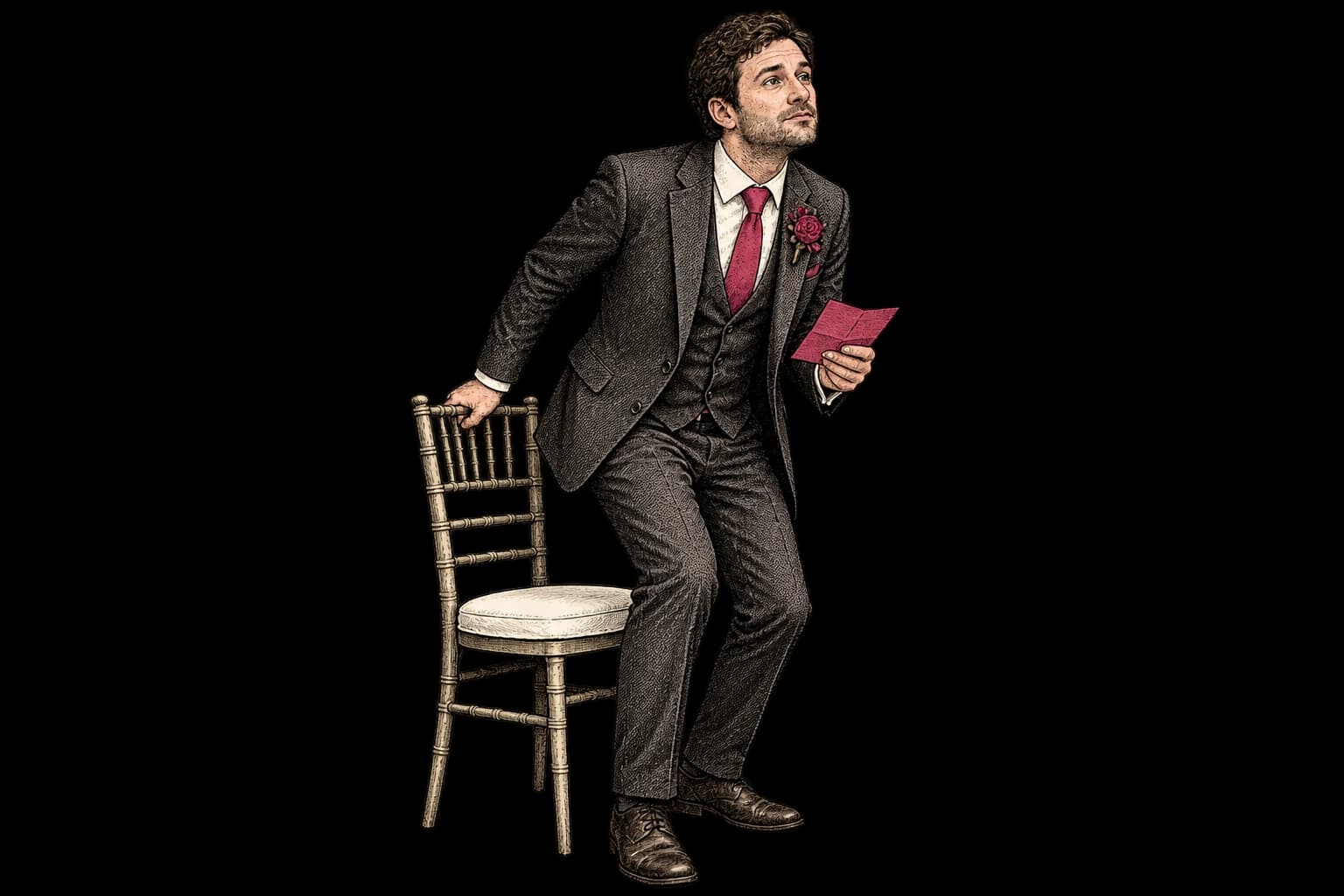
The first line can hold up the whole speech. You write it, decide it sounds like someone else, delete it and spend another evening looking for a better joke.
You don’t need a spectacular entrance. You need a clear beginning: let people settle, tell them who you are and give them a reason to listen. A small, true detail about the groom can do more work than a borrowed punchline.
Here are three ways in, ten fictional examples and a practical way to rehearse the opening. Use the shapes, then put your own material inside them.
What the opening needs to do
Think of the opening as a short introduction to you and your relationship with the groom. The room contains people who know both of you, people who know one of you and people wondering whether the coffee is coming.
Give them enough context to follow the first story. That usually means your name, how you know him and one useful detail. It does not require your complete friendship history.
“Good evening, I’m Sam, and I’ve known Dan since we shared a flat at university” is a perfectly serviceable start. If that sounds like you, use it. There is no prize for making an introduction more complicated.
The first twenty seconds are a useful rehearsal target, not a stopwatch rule. Let the greeting and first thought breathe. You can add a joke if you have one that belongs there; the speech still works without it.
Choose one of three ways in
1. Introduce yourself, then add a detail
This is the straightforward option. Say who you are, establish the connection and offer a glimpse of the person you know.
I’m Sam, Dan’s old flatmate. We lived together for three years. I learnt a lot about him, and considerably more about which plates can survive a microwave.
The relationship is clear before the joke arrives. The next sentence can lead into a real story about living together. Don’t use the microwave detail unless something like it actually happened.
2. Start with a small scene
You can open inside a memory, then introduce yourself immediately afterwards. This works when the scene is easy to understand without a list of names or an explanation of your job.
The first time I met Dan, he was labelling a shelf in our shared fridge. I’m Sam, his old flatmate. That shelf was the beginning of a surprisingly durable friendship.
A scene gives the audience something to picture. It is less useful if you need a minute of explanation before anyone understands why it matters. If the room needs your name first, give it to them first.
3. Begin warmly and plainly
You can start with affection. You don’t have to disguise it as a joke or save every sincere sentence for the end.
I’m Sam, Dan’s brother. I’ve been looking forward to saying this: Dan and Priya, it’s lovely to see you both so happy today. I’d like to tell you a little about the brother I grew up with.
Use words you can say honestly. This opening turns naturally towards a childhood story; it doesn’t need a comedy line bolted on before you get there.
All examples in this guide are invented. They illustrate a writing approach, not real weddings or customer stories.
Seven more opening lines to adapt
Together with the three examples above, these give you ten possible starting points. They are options, not a script to string together. Replace the names, relationships and details with things you can stand behind.
The long friendship
I’m Will. Ben and I met in year seven, when our biggest shared responsibility was remembering a PE kit. I’m pleased to report that one of us is now trusted with wedding rings.
The contrast is small and recognisable. Only keep the rings detail if it is your role at this wedding.
The organised friend
I’m Alex, Tom’s friend from work. Tom sent me a spreadsheet for today. My speech has its own row. I’m trying very hard not to turn it red.
Use a habit people recognise, rather than assigning the groom a comic personality he doesn’t have.
The reliable friend
I’m Joe. If you need a lift, a spare key or someone to help carry a sofa, Matt is the person you ring. I’ve tested all three, which is why I’m very pleased to be here for him today.
This can lead straight into one occasion when he showed up. No punchline is required.
The sibling
I’m Adam, Luke’s younger brother. Growing up, I inherited his clothes, his bike and a fairly optimistic account of whose fault things were. Today, I get to give him something back.
Keep the teasing affectionate. The next thought should make “something back” feel like a tribute, not a threat.
The shared hobby
I’m Rob, James’s walking partner. We’ve spent a lot of weekends following routes he described as “mostly flat”. It’s nice to be here with a chair nearby.
One recognisable detail is enough. Save the full explanation of your hobby for another occasion.
The first meeting
I’m Chris. I met Ollie on my first day in a new job. He showed me where everything was, introduced me to everyone and quietly warned me which mug belonged to the boss.
This sets up a story about kindness through an ordinary action. It does not need a dramatic ending to earn its place.
The simple welcome
Good evening, I’m George, Harry’s best man. Harry and Amira, thank you for asking me to be part of today. I’ve got a couple of stories, and one thing I particularly want you both to hear.
Only promise what the speech delivers. Have that sincere thought ready before you write the opening around it.
Make the second sentence easy
A good first line can still leave you stranded if you haven’t decided what comes after it. Write the opening and the first story together, even if you later shorten the introduction.
Try this sequence: introduce the connection, give a specific detail, then move into the memory that explains it. For the reliable-friend opening, the next sentence could be: “When I moved house last autumn, Matt arrived before the removal van.”
That sentence gives you a place to go. “Anyway, on to the speech” sends you back to the beginning.
If the opening is a joke you found online and the next paragraph is a personal story, read the join aloud. If they sound like different people wrote them, start with the personal story and build a simpler introduction around it.
For the rest of the structure, use our best man speech template.
What to leave out of the opening
- An apology for speaking. You can feel nervous without announcing that the speech will be terrible. Start with your name or your first thought.
- A threat about what you could reveal. “I’ve got enough material to ruin him” makes the room wait for damage. Choose an affectionate story instead.
- A joke that targets someone who hasn’t agreed to it. The couple’s past relationships, sex life and private difficulties aren’t convenient opening material.
- A long list of thanks. Agree any formal thanks with the couple and other speakers. Avoid repeating a list simply because a template included one.
- A promise to be hilarious. Let the audience meet you before setting them a test of your comedy.
“For those who don’t know me” is not a disaster. It is just a phrase you can usually trim to “I’m…”. Spend more effort finding a true detail than policing six harmless words.
If a borrowed line sounds suspiciously familiar, check our banned list before giving it another outing.
Rehearse the moment before the words
Practise standing up, finding the first line and saying it at a comfortable pace. The physical start is part of the opening too.
- Check with the organiser how you will be introduced and whether there is a microphone. Try the microphone beforehand if you can.
- Put the opening on your first card in type you can read easily. Start the next thought on a new line.
- When it is your turn, get settled and give the room a moment to quieten. You don’t need to speak over chairs moving.
- Look up, say the first sentence and leave a little space before the next. Practise that pause as well as the words.
- Record one run-through. Listen for phrases you keep stumbling over and shorten them into language you actually use.
You don’t need to memorise every syllable. Being familiar with the first few thoughts can make the notes easier to use when you stand up.
If the first joke gets no laugh
Leave a brief pause, then carry on with the next sentence you rehearsed. A quiet response doesn’t require an explanation, another joke or a comment about the audience.
Avoid “tough crowd” or “that was supposed to be funny”. Both ask the guests to deal with your reaction instead of listening to the speech.
If you lose your place, a plain “Let me find where I was” is enough. Look at your card and resume. It doesn’t need to become a performance of going wrong.
If you’d be comfortable saying the opening even without a laugh, you have something useful. It can introduce you, tell the room something true and lead into the next thought. That is plenty for a beginning.
Start with a person you know. Say something true. Give yourself a next sentence.