
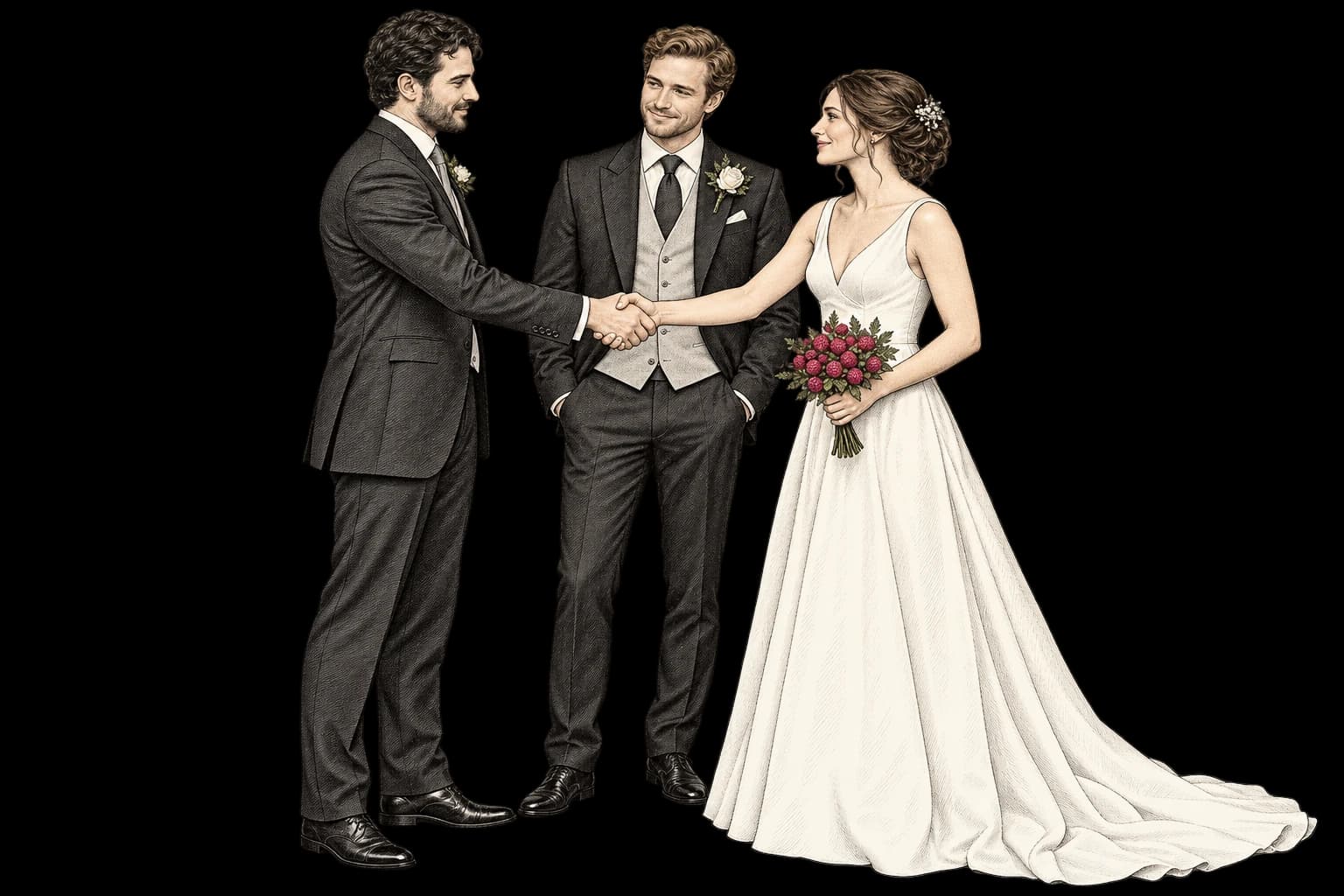
You’ve known the groom for fifteen years. You’ve met the bride four times, and one of those was a hello in a hallway. Now you need to say something about her in front of people who have known her all her life.
You don’t need to pretend those four meetings were a lifelong friendship. A short, specific acknowledgement is a better starting point than a paragraph of compliments you can’t explain. The job is to include her warmly, as a person, while being honest about what you know.
What do you say when you barely know her?
Start with something you’ve genuinely noticed about the bride. If you don’t have a useful memory, ask for one, check it, and be clear about where it came from. Add a sincere wish for the couple without claiming a closeness you haven’t built.
You can also talk about what you’ve seen of the relationship. But don’t make every sentence about how she has improved, organised or rescued the groom. She deserves to appear in her own right, not just as his character development.
Nor do you need to announce precisely how many times you’ve met. If the distance matters to the story, acknowledge it briefly. Otherwise, start with the detail you do have.
Find one detail about her, not just him
Think back to the occasions when you were in the same room. What did she talk about? What did she make time for? Was there a small moment that showed her humour, enthusiasm or consideration?
A fictional example: at a busy dinner, Priya noticed you hadn’t met anyone and brought you into the conversation. That gives you something you can describe. “Priya is lovely” doesn’t tell the room nearly as much.
Keep the scale of the claim honest. One thoughtful introduction lets you thank her for that moment. It doesn’t prove that she has always been everyone’s favourite person.
If your only material is about the couple, use it, but make time to learn one thing about her too. Ask what she enjoys or what her friends value about her, rather than just asking how she makes the groom happy.
Ask a few ordinary questions
You’re looking for a detail you can use responsibly, not a secret nobody else has heard.
Ask the groom:
- What does she get absorbed in when she has a free afternoon?
- What is something she did recently that she was pleased about?
- What would her friends recognise as very her?
If you know one of her friends, you can ask for a small story with permission to mention it. Try: “I’m writing the speech and don’t know Priya well yet. Is there something about her you’d be happy for me to include? Nothing private.”
Check the names, the detail and whether it is suitable for the room. A story being true doesn’t automatically make it yours to share. Avoid asking for embarrassing material and then hoping a kind delivery will make it all right.
If there is time for a normal conversation before the wedding, have one. It needn’t become a speech interview. Get to know the person; the material is a possible side effect.
If someone gives you a story, attribute it naturally. “Her sister told me…” is honest. “I’ll never forget the time…” isn’t, if you weren’t there.
Three honest ways into the paragraph
These are fictional examples to show the shape of the writing. Don’t use their incidents as though they happened to you.
Something you saw
“Priya, at the first dinner we shared, you noticed I didn’t know anyone at your end of the table and pulled me into the conversation. I was grateful then, and I’m glad we’ll have plenty more chances to get to know each other.”
A specific moment, a direct thank-you and a modest statement about the future. It doesn’t claim that one dinner told you everything about her.
Something you’ve been told, clearly attributed
“Your sister told me you’ve spent the last year helping her learn to drive, and that you still answer her calls. I haven’t known you long, Priya, but I’m looking forward to hearing your version of those lessons.”
You would need to check that both people were happy for this to be mentioned. The attribution matters: the speaker is passing on a story, not adopting someone else’s memory.
A small moment with the couple
“At dinner last month, you and Chris spent ten minutes disagreeing about which station you’d got lost at. Neither of you could remember the station. Both of you remembered where you had lunch. I’m looking forward to hearing about the next trip.”
This is an observation about a shared experience. Keep it alongside something about her as a person, rather than making the entire section a review of their compatibility.
The useful pattern is simple: a real detail, an honest perspective, a warm finish. There is no requirement to fit it into exactly two sentences.
How much of the speech should be about the bride?
There isn’t a universal percentage or mandatory word count. Give her enough space to be acknowledged properly without stretching limited knowledge into a biography.
For a first draft, try a short paragraph containing one specific detail and a direct, sincere line to her. Read it aloud with the rest of the speech. If it feels like a token sentence squeezed between two long stories about the groom, rebalance it. If you’re repeating generic praise, cut the repetition and keep the detail.
Our best man speech template places the partner section after the groom stories, followed by the sincere turn and the toast. Its word budgets are planning aids, not a quota you have to fill with invented intimacy.
You can mention the couple earlier too. A structure should help the speech flow, not keep the bride waiting in a designated paragraph until you’re ready for her.
What to leave out
Avoid the shrug: “I don’t really know her, but she seems nice.” It draws attention to the distance and gives her nothing in return.
Leave out the invented certainty: “From the moment we met, I knew you were perfect for him.” If that isn’t what you thought, don’t write it because it sounds like a wedding speech.
Don’t fall back on “she’s finally sorted him out” or “thanks for taking him off our hands”. Those lines give her a job rather than a personality. And avoid turning unfamiliarity into a joke at her expense.
A compliment about her appearance doesn’t fill the gap either. Find something more personal to say about what she does, cares about or has shared with you. That is a writing choice, not a rule about who is allowed to compliment whom.
Keep exes, comparisons and your own romantic history out of the speech. A wedding microphone is a poor place for a revelation, even one introduced as a joke. The banned list can help you spot other lines you’ve heard too often.
If you know her and the relationship is difficult
Not knowing someone well and not getting on with them are different problems. Neither is a reason to use the speech to make a point.
You don’t have to invent affection or announce that you think the couple are perfect together. Look for something you can say sincerely: thank them for including you, acknowledge a real shared occasion, or offer a straightforward wish for their future.
Don’t assume “I’ve never seen him happier” is a safe substitute. Only say it if it reflects what you believe. The same goes for claims that she has changed him for the better.
Leave out pointed pauses, private irony and compliments that are really criticisms. If you’re struggling to give the speech in good faith, speak to the groom privately about the role before the wedding. Serious concerns belong in a separate, appropriate conversation, not in a coded line delivered to the room.
Put it into the speech
Make three notes before you write: what you know first-hand, what someone else has told you and what you still need to check. Keep those categories distinct as you draft.
Choose one detail. Write to the bride directly if that feels natural. Then read the paragraph beside the rest of the speech and ask: does she appear as a person here, or only as something that happened to the groom?
Use the five-part template to put the paragraph in context. Agree any particular thanks or toasts with the couple or the person coordinating the speeches rather than adding them because another wedding did them that way.
If you’d like help starting from your memories of the groom, you can try the free opener. Check any wording about the bride against what you actually know before using it.
You don’t need to pretend you know her well. You do need to make room for her.